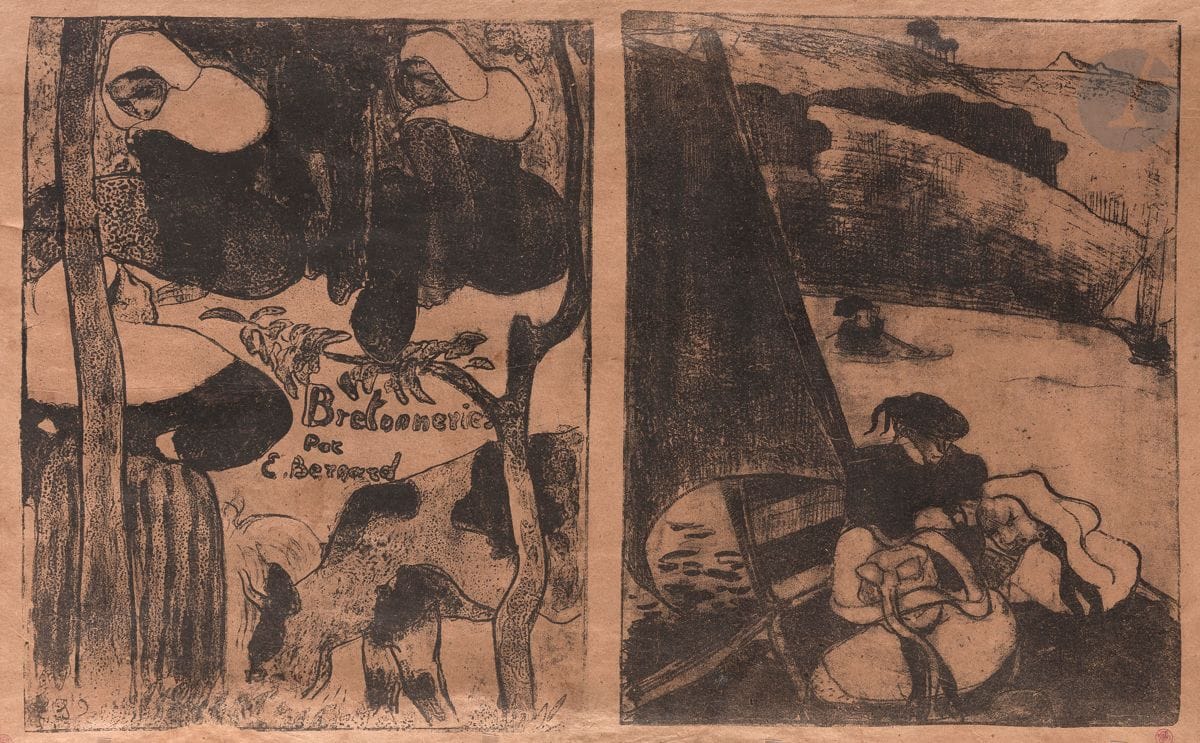
Émile Bernard (1868-1941) Title page (Trois femmes et une vache dans un pré); Bretons en barque sur l'Aven, ou Le Retour du pardon (Pl. des Bretonneries). 1889. Zincography. [550 x 370]. Morane 9 and 10. Exceptional and to date the only known trial proof of the two subjects printed on a single sheet of buff vellum, finely lined on japon pelure. Horizontal tear of 55 mm at the left edge, reaching the tree trunk. Another long oblique fracture above the word "Bretonneries". Minimal tears and small holes at the edges of the sheet, inherent to the texture of the paper. Stamp R. T. (bottom left and right again). Provenance (according to a handwritten note by the owner on the reverse of the mount): "Mélanie à Riec-sur-Belon (long framed in the restaurant room)". This print was featured in the Bibliothèque Nationale exhibition, Gauguin et l'École de Pont-Aven, 1989 (cited in the catalog p. 46) and in the Atlanta exhibition, Before and After Gauguin, 2008. "This suite of zincographs, a technique similar to lithography but in which the zinc plate replaces the porous limestone, printed in black was first shown at the Café Volpini during the Impressionist and Synthetist group's painting exhibition in May 1889. [...] The zincs began to be drawn at the end of 1888 while Gauguin was still in Arles, and the work was completed in the early months of 1889. These rather "rustic" plates do not have the finish of Gauguin's, and it is doubtful that the black print was made by a professional printer of Ancourt's quality. [...] For us, it is certain that the plates presented were in black, not colored. Presented at the same time as those by Gauguin printed in black, a special mention would have been made in the catalog if they had been watercolor proofs. The coloring only came later, in an attempt to sell them". (D. Morane, Emile Bernard, catalog raisonné de l'œuvre gravé, Musée de Pont-Aven, Bibliothèque d'Art et d'Archéologie Jacques Doucet, Paris, 2000, p. 19). "The catalog for the Volpini exhibition in Paris in May 1889 mentions "visible on request an album of lithographs by Paul Gauguin and Émile Bernard". But in the absence of a more precise list, as with the paintings [...] we still don't know what Émile Bernard is presenting. While art historians agree that it was Les Bretonneries, we cannot, in the present state of knowledge, specify exactly how many plates were exhibited, or in what order." (M. Grivel, ed., Gauguin et l'École de Pont-Aven, exhibition catalog, Paris, Bibliothèque nationale, 1989, p. 49). "This is [...] the triumph of synthetism, with the crushing of perspective, the simplification of lines, the broad flat tints used in watercolor to make color sing. The influence of the Japanese and Hiroshige's truncated compositions can also be seen here: the cut sail of the Bretons on the Aven is reminiscent of Arai Watasbi-bune (plate 32 of Tokaido)...". (M. Grivel, ed., Gauguin et l'École de Pont-Aven, exhibition catalog, Paris, Bibliothèque nationale, 1989, p. 49).
Estimate
€1,500 - €1,800
Result
€4,864
Buyer's premium
28%
Émile Bernard (1868-1941)
Title page (Trois femmes et une vache dans un pré); Bretons en barque sur l'Aven, ou Le Retour du pardon (Pl. des Bretonneries). 1889. Zincography. [550 x 370]. Morane 9 and 10. Exceptional and to date the only known trial proof of the two subjects printed on a single sheet of buff vellum, finely lined on japon pelure. Horizontal tear of 55 mm at the left edge, reaching the tree trunk. Another long oblique fracture above the word "Bretonneries". Minimal tears and small holes at the edges of the sheet, inherent to the texture of the paper. Stamp R. T. (bottom left and right again).
Provenance (according to a handwritten note by the owner on the reverse of the mount): "Mélanie à Riec-sur-Belon (long framed in the restaurant room)".
This print was featured in the Bibliothèque Nationale exhibition, Gauguin et l'École de Pont-Aven, 1989 (cited in the catalog p. 46) and in the Atlanta exhibition, Before and After Gauguin, 2008.
"This suite of zincographs, a technique similar to lithography but in which the zinc plate replaces the porous limestone, printed in black was first shown at the Café Volpini during the Impressionist and Synthetist group's painting exhibition in May 1889. [...]
The zincs began to be drawn at the end of 1888 while Gauguin was still in Arles, and the work was completed in the early months of 1889.
These rather "rustic" plates do not have the finish of Gauguin's, and it is doubtful that the black print was made by a professional printer of Ancourt's quality. [...]
For us, it is certain that the plates presented were in black, not colored. Presented at the same time as those by Gauguin printed in black, a special mention would have been made in the catalog if they had been watercolor proofs.
The coloring only came later, in an attempt to sell them". (D. Morane, Emile Bernard, catalog raisonné de l'œuvre gravé, Musée de Pont-Aven, Bibliothèque d'Art et d'Archéologie Jacques Doucet, Paris, 2000, p. 19).
"The catalog for the Volpini exhibition in Paris in May 1889 mentions "visible on request an album of lithographs by Paul Gauguin and Émile Bernard". But in the absence of a more precise list, as with the paintings [...] we still don't know what Émile Bernard is presenting. While art historians agree that it was Les Bretonneries, we cannot, in the present state of knowledge, specify exactly how many plates were exhibited, or in what order." (M. Grivel, ed., Gauguin et l'École de Pont-Aven, exhibition catalog, Paris, Bibliothèque nationale, 1989, p. 49).
"This is [...] the triumph of synthetism, with the crushing of perspective, the simplification of lines, the broad flat tints used in watercolor to make color sing. The influence of the Japanese and Hiroshige's truncated compositions can also be seen here: the cut sail of the Bretons on the Aven is reminiscent of Arai Watasbi-bune (plate 32 of Tokaido)...". (M. Grivel, ed., Gauguin et l'École de Pont-Aven, exhibition catalog, Paris, Bibliothèque nationale, 1989, p. 49).
Sale
Wednesday 20 September 2023・14:30 (Europe/Paris)
Sale location coming soon
3, rue Favart
75002 Paris