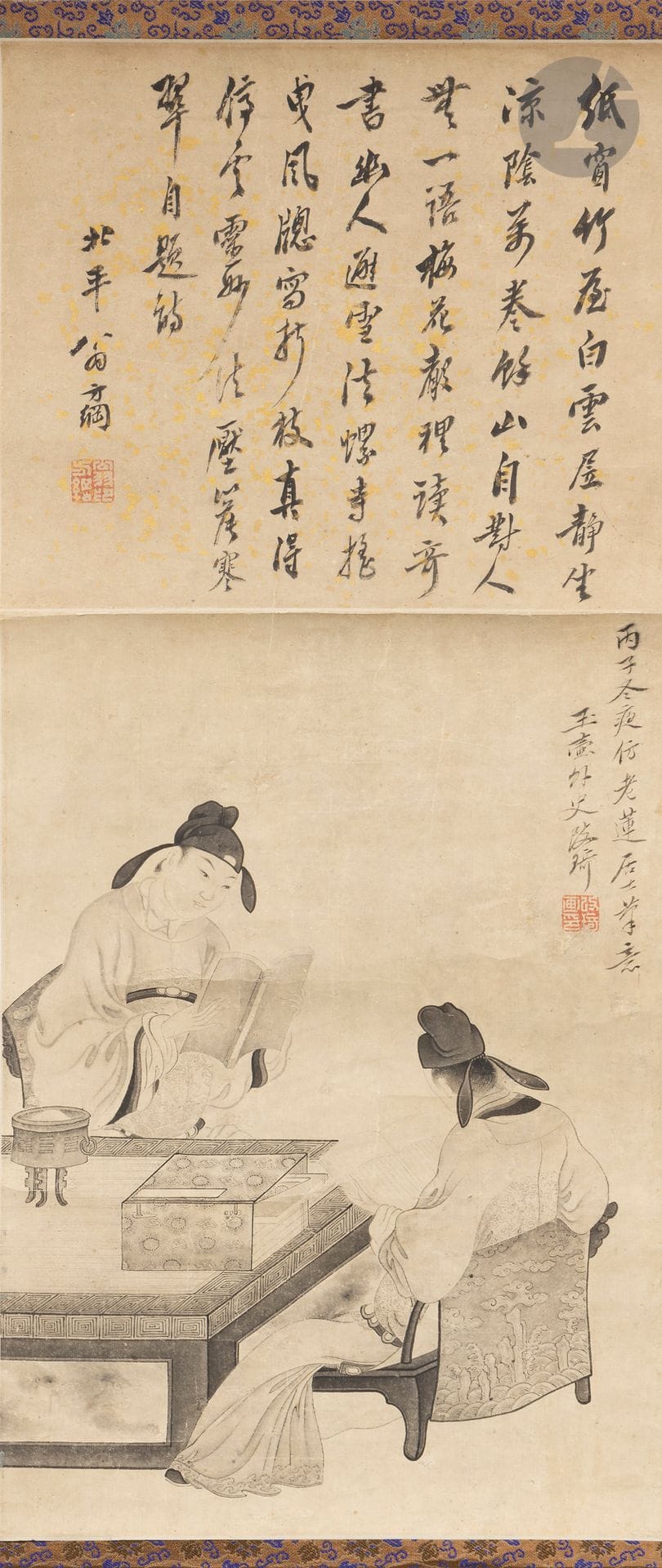
Gai Qi, 改琦 (1773-1828), sumi e painting mounted as a kakemono decorated with two lettrés, China, Jiaqing period (1796-1820) Painting in the traditional Baimiao* style. Ink on paper sprinkled with gold leaf flakes in the upper part, decorated with two scholars wearing the traditional Chuijiao Putou headdress, born during the Tang period. They are busy reading, seated on low armchairs facing a table on which a bronze incense burner and a box of books rest. The painting is illustrated at the top with a poem signed Weng Fanggang with a red seal. 紙窗竹屋白雲居 / 靜坐涼陰萬卷余 / 山月對人無一語 / 梅花聲裏讀奇書 / 幽人避雪法螺寺 / 搖曳風窗雪折枝 / 真得停雲靈妙法 / 壓簾寒翠自題詩 / 北平 翁方綱, Zhi chuang zhu wu bai yun ju / jing zuo liang yin / wan juan yu / shan yue dui ren wu yi yu / mei hua sheng li du qi shu / you ren bi xue fa luo si / yao ye feng chuang xue zhe zhi / zhen de ting yun ling miao fa / ya lian han cui zi ti shi / Beiping** WENG Fanggang. "A bamboo house with paper windows, as if in the midst of white clouds, / Sitting quietly in the cool shade, thousands of rolls of books surplus, / The mountain moon doesn't say a word to people, / To the sound of plum blossoms, I read amazing books. / The hermits avoid the snow at the Fa Luo temple, / The branches bend under the snow in front of the windy window, / Thanks to the marvellous magic of the motionless clouds, / The green branches in the cold pressing on the curtain seem to be writing a poem all by themselves, / Beiping** WENG Fanggang". Inscribed lower right: 丙子冬瘦仿老蓮居士筆意玉壶外史改琦, Bing zi dong shou fang lao lian ju shi bi yi / Yu hu wai shi GAI Qi, "in winter of the Bingsi year, following the artistic spirit of Lao lian ju shi". Signed: Yu hu wai shi GAI Qi with a red seal. On the closed scroll, a brown-backed paper label with the inscription: 改七薌白描人物 - Gai Qi Xiang baimiao renwu - "character painting by Gai Qi Xiang using the baimiao technique". Sight size: 59 x 26.3 cm Creases and tears, repairs. Weng Fanggang, 翁方綱 (1733-1818), was a Chinese calligrapher, literary critic, philosopher and poet of the Qing dynasty. Originally from Beijing's Daxing district, Weng attracted the attention of the Qianlong emperor, who was impressed by his translation of Tao Yuanming's "Spring of Peach Blossoms" (桃花源, Tao Hua Yuan) into the Manchu language. Employed at court as a young compiler, he later became a member of the Grand Secretariat. Although he held government posts in Shandong, Jiangxi and Jiangsu, Weng spent most of his working life in Beijing, in order to be close to the literati of his day. Gai Qi, 改琦 (1773-1828), courtesy name Bowen, 伯蕰, artist names Qiliang, 七郎 and Yuhu Waishi, 玉壶外史, was a poet and painter born in western China during the Qing dynasty. As an artist, he was active in Shanghai. His paintings mainly concern plants, beauty and people. However, he also produced many landscapes. In poetry, he preferred the rhymed cí form and added such poems to his paintings. His social circle included eminent scholars as well as artists. He organized a literary society and a Buddhist lay society. His works are often executed in the delicate baimiao (outline) style, which is the case of the painting presented. *Baimiao: a brush technique that produces a finely controlled, supple ink outline drawing, without any embellishment of color or wash (diluted ink or paint applied in broad stripes). It is commonly used for figure painting, where precision of description is important. **Beiping: former name of Beijing.
Estimate
€1,200 - €1,500
Result
€1,280
Buyer's premium
28%
Gai Qi, 改琦 (1773-1828), sumi e painting mounted as a kakemono decorated with two lettrés, China, Jiaqing period (1796-1820)
Painting in the traditional Baimiao* style. Ink on paper sprinkled with gold leaf flakes in the upper part, decorated with two scholars wearing the traditional Chuijiao Putou headdress, born during the Tang period. They are busy reading, seated on low armchairs facing a table on which a bronze incense burner and a box of books rest. The painting is illustrated at the top with a poem signed Weng Fanggang with a red seal. 紙窗竹屋白雲居 / 靜坐涼陰萬卷余 / 山月對人無一語 / 梅花聲裏讀奇書 / 幽人避雪法螺寺 / 搖曳風窗雪折枝 / 真得停雲靈妙法 / 壓簾寒翠自題詩 / 北平 翁方綱, Zhi chuang zhu wu bai yun ju / jing zuo liang yin / wan juan yu / shan yue dui ren wu yi yu / mei hua sheng li du qi shu / you ren bi xue fa luo si / yao ye feng chuang xue zhe zhi / zhen de ting yun ling miao fa / ya lian han cui zi ti shi / Beiping** WENG Fanggang. "A bamboo house with paper windows, as if in the midst of white clouds, / Sitting quietly in the cool shade, thousands of rolls of books surplus, / The mountain moon doesn't say a word to people, / To the sound of plum blossoms, I read amazing books. / The hermits avoid the snow at the Fa Luo temple, / The branches bend under the snow in front of the windy window, / Thanks to the marvellous magic of the motionless clouds, / The green branches in the cold pressing on the curtain seem to be writing a poem all by themselves, / Beiping** WENG Fanggang". Inscribed lower right: 丙子冬瘦仿老蓮居士筆意玉壶外史改琦, Bing zi dong shou fang lao lian ju shi bi yi / Yu hu wai shi GAI Qi, "in winter of the Bingsi year, following the artistic spirit of Lao lian ju shi". Signed: Yu hu wai shi GAI Qi with a red seal. On the closed scroll, a brown-backed paper label with the inscription: 改七薌白描人物 - Gai Qi Xiang baimiao renwu - "character painting by Gai Qi Xiang using the baimiao technique".
Sight size: 59 x 26.3 cm
Creases and tears, repairs.
Weng Fanggang, 翁方綱 (1733-1818), was a Chinese calligrapher, literary critic, philosopher and poet of the Qing dynasty. Originally from Beijing's Daxing district, Weng attracted the attention of the Qianlong emperor, who was impressed by his translation of Tao Yuanming's "Spring of Peach Blossoms" (桃花源, Tao Hua Yuan) into the Manchu language. Employed at court as a young compiler, he later became a member of the Grand Secretariat. Although he held government posts in Shandong, Jiangxi and Jiangsu, Weng spent most of his working life in Beijing, in order to be close to the literati of his day. Gai Qi, 改琦 (1773-1828), courtesy name Bowen, 伯蕰, artist names Qiliang, 七郎 and Yuhu Waishi, 玉壶外史, was a poet and painter born in western China during the Qing dynasty. As an artist, he was active in Shanghai. His paintings mainly concern plants, beauty and people. However, he also produced many landscapes. In poetry, he preferred the rhymed cí form and added such poems to his paintings. His social circle included eminent scholars as well as artists. He organized a literary society and a Buddhist lay society. His works are often executed in the delicate baimiao (outline) style, which is the case of the painting presented. *Baimiao: a brush technique that produces a finely controlled, supple ink outline drawing, without any embellishment of color or wash (diluted ink or paint applied in broad stripes). It is commonly used for figure painting, where precision of description is important. **Beiping: former name of Beijing.
Sale
Tuesday 12 December 2023・14:00 (Europe/Paris)
Salle 11 - Hôtel Drouot
9, rue Drouot
75009 Paris