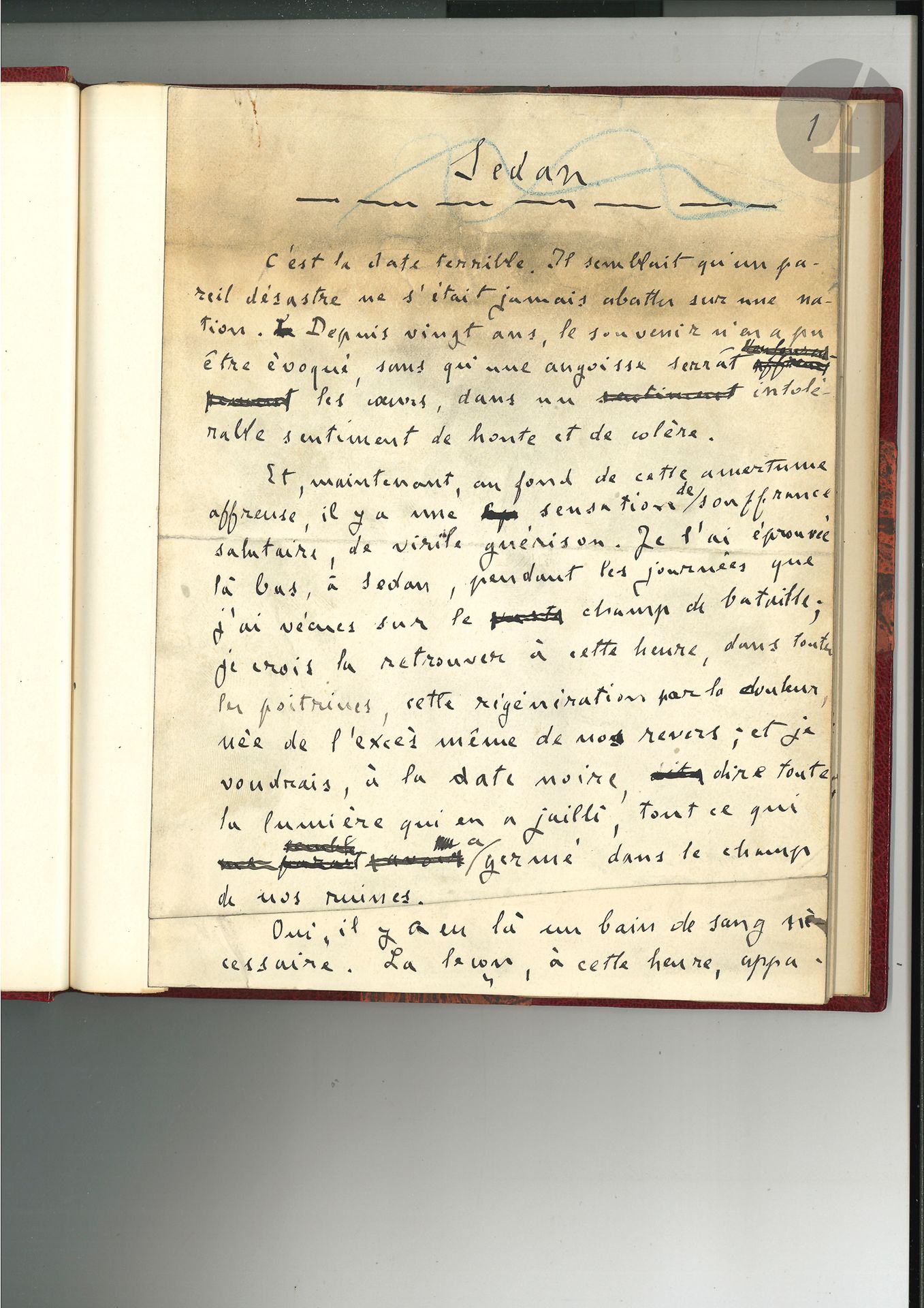
Émile ZOLA. Autograph manuscript signed, Sedan, [1891]; 17 pages and a half small in-4 (20.5 x 15.5 cm), cut out for printing and glued back together, mounted on tabs and bound in one vol. half-garnet morocco with corners (Conil-Septier). Important article on the disaster of Sedan and the defeat of 1870, on his return from a documentation trip to Sedan for his novel La Débâcle. In preparation for his novel La Débâcle, the penultimate volume in the Rougon-Macquart series (1892). Zola visited Sedan and the battlefields from April 17 to 26, 1891. On his return, on the anniversary of the Sedan disaster, he published this article in Le Figaro on September 1, 1891, a historical reflection that foreshadows the spirit of the novel. The manuscript, in black ink, shows erasures and corrections; it was cut out for printing, then reassembled. The article, published on the front page of Le Figaro, was prefaced by this caption: "It's difficult to say anything new about Sedan. But we thought it would be interesting to ask M. Émile Zola, who traveled to all the battlefields of 1870 to collect documents for his book on the war, to give us his impression of this disastrous date." Zola begins: "It's a terrible date. It seemed as if such a disaster had never befallen a nation. For twenty years, the memory of it could not be evoked without an anguish gripping hearts, in an intolerable feeling of shame and anger. And now, in the depths of that awful bitterness, there's a feeling of salutary suffering, of virile healing. I felt it there, at Sedan, during the days I spent on the battlefield; I believe I find it again at this hour, in every breast, this regeneration through pain, born of the very excess of our setbacks; and I would like, at the black date, to speak of all the light that has sprung from it, all that has germinated in the field of our ruins. Yes, it was a necessary bloodbath. The lesson, at this hour, appears both appalling and profitable. This blow to our pride, this bloodletting of our veins, was perhaps all that remained to restore us to health." For Zola, defeat was inevitable. "For nearly a year now that I've been immersed in the documents of the time, everything I read, everything I'm told, points to the forced, mathematical crushing of our armies". More than the immense faults committed, "at the deep, hidden source where the facts of history are born, there are the primary causes, physiological and psychological, which decide the existence of a nation. If our seven army corps were scattered from Metz to Belfort, in such confusion that they were unable to take the offensive; if Mac-Mahon let himself be beaten at Froeschwiller, unaware of the enemy attacking him, losing the game, to the point of being swept all the way to Châlons; if, later on, instead of wisely waiting for the Prussians under Paris, as he and everyone else wanted, he ended up obeying the mad push that was to throw him into Sedan; if, for his part, Bazaine stubbornly held out in front of Metz, at first perhaps through blindness and incapacity, then for some obscure purpose: all these facts, it has to be said, these imbecilic facts accumulated as if for pleasure, were not individual faults, due simply to unfortunate generals, mediocre or ambitious personalities, but foolishness, crimes of lèse-patrie, committed by the entire nation, and in which each of us had his share of responsibility. Today, there's no shame in examining our conscience. Faced with Germany, quivering from its victory over Austria, rejuvenated by its irresistible drive towards unity, led by learned and wise men, ready to rise as a whole at the first call, France was rotten to the core by its immobility in the pride of its warrior legend".... And if the Empire worsened the disaster, Zola points to other, older causes: the strategic inadequacy of leaders, insufficient equipment, "troops spoiled by expensive replacements" and undisciplined, "incapable of victory". And he drew this lesson: "to win, a people must be at the head of the peoples, I mean it must be the science, the health, the genius of its time. We had forgotten this, we had let ourselves be outdone, living in the vain confidence of our old glory. And that's how France, which had flown its victorious flags in all the capitals of Europe, when it was strength and intelligence, almost died of routine and stupidity, in the cesspool of Sedan. What a tragedy, this disaster
Estimate
€8,000 - €10,000
Result
€10,140
Buyer's premium
30%
Émile ZOLA. Autograph manuscript signed, Sedan, [1891]; 17 pages and a half small in-4 (20.5 x 15.5 cm), cut out for printing and glued back together, mounted on tabs and bound in one vol. half-garnet morocco with corners (Conil-Septier).
Important article on the disaster of Sedan and the defeat of 1870, on his return from a documentation trip to Sedan for his novel La Débâcle.
In preparation for his novel La Débâcle, the penultimate volume in the Rougon-Macquart series (1892). Zola visited Sedan and the battlefields from April 17 to 26, 1891. On his return, on the anniversary of the Sedan disaster, he published this article in Le Figaro on September 1, 1891, a historical reflection that foreshadows the spirit of the novel.
The manuscript, in black ink, shows erasures and corrections; it was cut out for printing, then reassembled.
The article, published on the front page of Le Figaro, was prefaced by this caption: "It's difficult to say anything new about Sedan. But we thought it would be interesting to ask M. Émile Zola, who traveled to all the battlefields of 1870 to collect documents for his book on the war, to give us his impression of this disastrous date."
Zola begins: "It's a terrible date. It seemed as if such a disaster had never befallen a nation. For twenty years, the memory of it could not be evoked without an anguish gripping hearts, in an intolerable feeling of shame and anger. And now, in the depths of that awful bitterness, there's a feeling of salutary suffering, of virile healing. I felt it there, at Sedan, during the days I spent on the battlefield; I believe I find it again at this hour, in every breast, this regeneration through pain, born of the very excess of our setbacks; and I would like, at the black date, to speak of all the light that has sprung from it, all that has germinated in the field of our ruins. Yes, it was a necessary bloodbath. The lesson, at this hour, appears both appalling and profitable. This blow to our pride, this bloodletting of our veins, was perhaps all that remained to restore us to health."
For Zola, defeat was inevitable. "For nearly a year now that I've been immersed in the documents of the time, everything I read, everything I'm told, points to the forced, mathematical crushing of our armies". More than the immense faults committed, "at the deep, hidden source where the facts of history are born, there are the primary causes, physiological and psychological, which decide the existence of a nation. If our seven army corps were scattered from Metz to Belfort, in such confusion that they were unable to take the offensive; if Mac-Mahon let himself be beaten at Froeschwiller, unaware of the enemy attacking him, losing the game, to the point of being swept all the way to Châlons; if, later on, instead of wisely waiting for the Prussians under Paris, as he and everyone else wanted, he ended up obeying the mad push that was to throw him into Sedan; if, for his part, Bazaine stubbornly held out in front of Metz, at first perhaps through blindness and incapacity, then for some obscure purpose: all these facts, it has to be said, these imbecilic facts accumulated as if for pleasure, were not individual faults, due simply to unfortunate generals, mediocre or ambitious personalities, but foolishness, crimes of lèse-patrie, committed by the entire nation, and in which each of us had his share of responsibility. Today, there's no shame in examining our conscience. Faced with Germany, quivering from its victory over Austria, rejuvenated by its irresistible drive towards unity, led by learned and wise men, ready to rise as a whole at the first call, France was rotten to the core by its immobility in the pride of its warrior legend".... And if the Empire worsened the disaster, Zola points to other, older causes: the strategic inadequacy of leaders, insufficient equipment, "troops spoiled by expensive replacements" and undisciplined, "incapable of victory". And he drew this lesson: "to win, a people must be at the head of the peoples, I mean it must be the science, the health, the genius of its time. We had forgotten this, we had let ourselves be outdone, living in the vain confidence of our old glory. And that's how France, which had flown its victorious flags in all the capitals of Europe, when it was strength and intelligence, almost died of routine and stupidity, in the cesspool of Sedan. What a tragedy, this disaster
Sale
Monday 17 June 2024・14:00 (Europe/Paris)
Sale location coming soon
3, rue Favart
75002 Paris