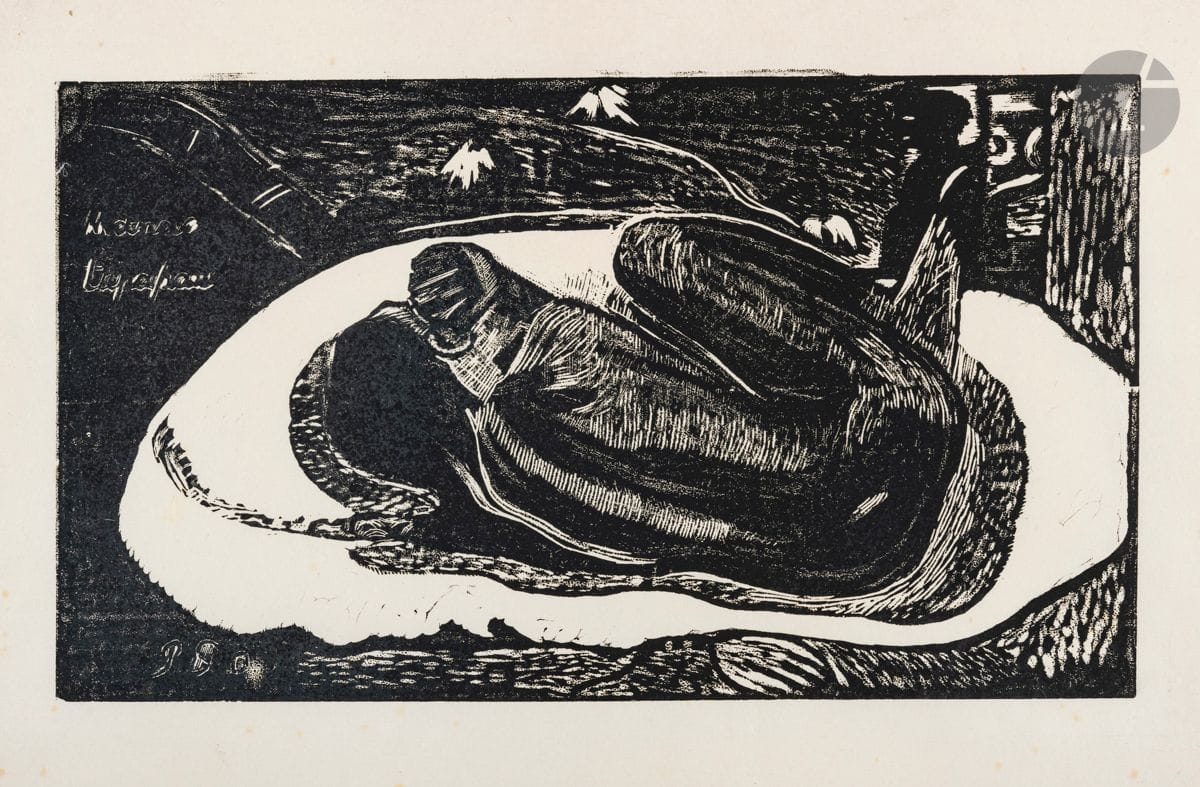
Paul Gauguin (1848-1903) Manaò Tupapaú (The Spirit of the Dead Watches). 1893-1894. Wood engraving. 355 x 205 [422 x 305]. Mongan, Kornfeld and Joachim 20 IV C. Very fine trial proof printed in black on japon, prior to the color print by Louis Roy, very carefully washed. Some light foxing. (This proof is cited by Mongan, Kornfeld and Joachim). Ex-coll. H. M. Petiet (Lugt 5031). This important etching is derived from the painting Mahana No Atua (The Day of God), dated 1894 and held at The Art Institute of Chicago, which constitutes "the culmination and synthesis of the Polynesian imagery of his first voyage and a foreshadowing of the more personal symbolism of his later years." (H. K. Stratis and A. Perelman, "Le jour de Dieu", in Gauguin L'alchimiste, exhibition cat., Paris, Musée d'Orsay and R.M.N., 2017, p. 202). The folded figure, on the right in the painting and here in the center of the print, recalls the pose of the Peruvian Chachapoya mummy discovered in 1877, which had fascinated the artist at the Musée d'Ethnographie du Trocadéro in Paris. "The traditional belief in tupapau - the spirits of the dead - is one of the rare vestiges of pre-colonial culture that Gauguin discovered in Tahiti, and which he described as a charming superstition. The inclusion of tupapau in his compositions, particularly the night scenes, enabled him to infuse an ominous, spiritual atmosphere into subjects otherwise firmly rooted in reality". (A. Perelman, "L'esprit des morts", op. cit., p. 194).
Estimate
€4,000 - €5,000
Result
€5,200
Buyer's premium
30%
Paul Gauguin (1848-1903)
Manaò Tupapaú (The Spirit of the Dead Watches). 1893-1894. Wood engraving. 355 x 205 [422 x 305]. Mongan, Kornfeld and Joachim 20 IV C. Very fine trial proof printed in black on japon, prior to the color print by Louis Roy, very carefully washed. Some light foxing. (This proof is cited by Mongan, Kornfeld and Joachim). Ex-coll. H. M. Petiet (Lugt 5031).
This important etching is derived from the painting Mahana No Atua (The Day of God), dated 1894 and held at The Art Institute of Chicago, which constitutes "the culmination and synthesis of the Polynesian imagery of his first voyage and a foreshadowing of the more personal symbolism of his later years." (H. K. Stratis and A. Perelman, "Le jour de Dieu", in Gauguin L'alchimiste, exhibition cat., Paris, Musée d'Orsay and R.M.N., 2017, p. 202). The folded figure, on the right in the painting and here in the center of the print, recalls the pose of the Peruvian Chachapoya mummy discovered in 1877, which had fascinated the artist at the Musée d'Ethnographie du Trocadéro in Paris.
"The traditional belief in tupapau - the spirits of the dead - is one of the rare vestiges of pre-colonial culture that Gauguin discovered in Tahiti, and which he described as a charming superstition. The inclusion of tupapau in his compositions, particularly the night scenes, enabled him to infuse an ominous, spiritual atmosphere into subjects otherwise firmly rooted in reality". (A. Perelman, "L'esprit des morts", op. cit., p. 194).
Sale
Wednesday 27 November 2024・14:00 (Europe/Paris)
Sale location coming soon
3, rue Favart
75002 Paris