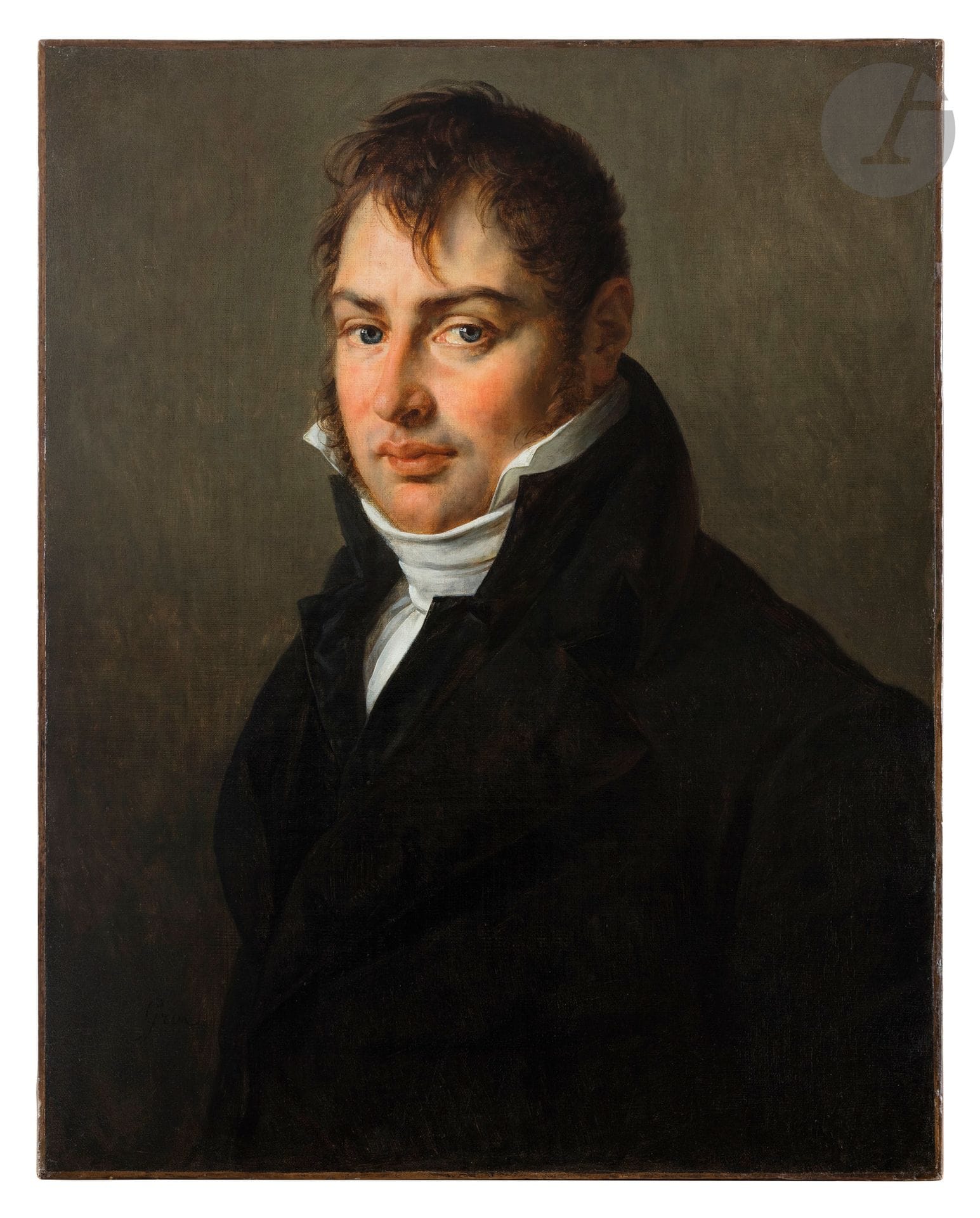
Antoine-Jean GROS known as Baron GROS (Paris 1771 - Meudon 1835) Presumed portrait of the artist Jean Vasserot (1769 - 1832) Canvas 73 x 59 cm Signed lower left "Gros (Old restorations) Provenance : - Probably from the collection of the model, Jean Vasserot (1769-1837) ; - By descent in the Vasserot family Kept until very recently in the family of the sitter's descendants, this portrait is not mentioned by the main biographers of Antoine-Jean Gros (J.-B. Delestre, J. Tripier Le Franc and most recently D. O'Brien). However, the attribution, based on the characteristic range of warm colors, the transparent brushstrokes used to create a powerful effect of presence, and the handwriting of the signature, is beyond doubt. Based on the family provenance and a comparison with a portrait dated 1791 by Jacques-Augustin Pajou, known as Pajou fils, featuring the same younger figure, it is possible to identify the latter with the landscape painter and draughtsman Jean Vasserot (1769-1832). Pajou's portrait belongs to the period when lasting ties were forged among the first students of the Paris workshops of David, Vincent and Regnault, who met up again and again to compete for the Academy's prizes. Such portraits of young friends were particularly prized among David's pupils, such as A.-L. Girodet, F. Gérard, J.-B. Isabey and Gros. We can assume that when Vasserot befriended Pajou, he, like Pajou, had ambitions to shine in the arts. In truth, he had a relatively modest career as a landscape painter, participating in the Salon from 1793 and declaring himself a pupil of P.-H. de Valenciennes in 1806. The height of his fame came around 1809-1810, when he was commissioned to paint the Château de Rambouillet as part of the renovation work ordered by Napoleon. As Gros had been in Italy from 1793 to 1799, he must have painted Vasserot's portrait after his return, in the years 1804-1809, a date suggested by the model's apparent age, between 35 and 39. Vasserot no longer has the ardor he expressed in 1791 when posing for Pajou, but the intensity of his gaze remains. The scarf wrapped around his neck, almost covering his chin, is perhaps a reminder of the coquettish attire favored by young Incroyables during the Directoire and Consulate periods. After the dazzling success of Les Pestiférés de Jaffa at the Salon of 1804, Gros went on to commission large-scale Napoleonic scenes and full-length portraits of imperial dignitaries in their court attire. His brushwork is animated by a Flemish Rubenism, but when he paints Vasserot, the pose and costume are distinguished by an unexpected sobriety, a quality he sometimes sought under the Restoration. The simplicity of the layout against a neutral background, a choice inaugurated by David and Vigée Le Brun on the eve of the Revolution, attests to a concern for modernity that Boilly and others marketed to a wider clientele. What sets Gros apart from his contemporaries, however, is his attention to integrating figure and background, in the manner of the colorist masters he admired. The modernity of the black frac celebrated in this portrait would have had multiple variations among the audience that populates the large painting Gros left in draft form showing Napoleon distributing awards to artists at the Salon of 1808 (Musée national du château de Versailles). We can assume that the portrait was inspired by a shared friendship. However, nothing is known about the relationship between Gros and Vasserot, including when and under what circumstances they met. Unlike his former studio-mates such as Isabey and Gérard, who under the Directoire and Consulate led a social life that brought them commissions and publicity, Gros seems to have opted for a more secluded lifestyle and less high-profile company, like Vasserot. We know that, as a battle painter, he liked to associate with the military, but Vasserot had a brother two years his junior, Louis, an officer knighted by Napoleon in 1810. The latter was no stranger to the art world, as the names of both brothers - "Vasserot l'aîné, peintre" and "Vasserot le jeune" - appear in the list of subscribers to Palais, maisons, et autres édifices modernes, dessinés à Rome, published by Ch. Percier and P. Fontaine in 1798. We would like to thank Professor Philippe Bordes for writing this note.
Estimate
€20,000 - €30,000
Result
Not sold
Buyer's premium
30%
Antoine-Jean GROS known as Baron GROS (Paris 1771 - Meudon 1835)
Presumed portrait of the artist Jean Vasserot (1769 - 1832)
Canvas
73 x 59 cm
Signed lower left "Gros
(Old restorations)
Provenance :
- Probably from the collection of the model, Jean Vasserot (1769-1837) ;
- By descent in the Vasserot family
Kept until very recently in the family of the sitter's descendants, this portrait is not mentioned by the main biographers of Antoine-Jean Gros (J.-B. Delestre, J. Tripier Le Franc and most recently D. O'Brien). However, the attribution, based on the characteristic range of warm colors, the transparent brushstrokes used to create a powerful effect of presence, and the handwriting of the signature, is beyond doubt. Based on the family provenance and a comparison with a portrait dated 1791 by Jacques-Augustin Pajou, known as Pajou fils, featuring the same younger figure, it is possible to identify the latter with the landscape painter and draughtsman Jean Vasserot (1769-1832). Pajou's portrait belongs to the period when lasting ties were forged among the first students of the Paris workshops of David, Vincent and Regnault, who met up again and again to compete for the Academy's prizes. Such portraits of young friends were particularly prized among David's pupils, such as A.-L. Girodet, F. Gérard, J.-B. Isabey and Gros.
We can assume that when Vasserot befriended Pajou, he, like Pajou, had ambitions to shine in the arts. In truth, he had a relatively modest career as a landscape painter, participating in the Salon from 1793 and declaring himself a pupil of P.-H. de Valenciennes in 1806. The height of his fame came around 1809-1810, when he was commissioned to paint the Château de Rambouillet as part of the renovation work ordered by Napoleon. As Gros had been in Italy from 1793 to 1799, he must have painted Vasserot's portrait after his return, in the years 1804-1809, a date suggested by the model's apparent age, between 35 and 39. Vasserot no longer has the ardor he expressed in 1791 when posing for Pajou, but the intensity of his gaze remains. The scarf wrapped around his neck, almost covering his chin, is perhaps a reminder of the coquettish attire favored by young Incroyables during the Directoire and Consulate periods.
After the dazzling success of Les Pestiférés de Jaffa at the Salon of 1804, Gros went on to commission large-scale Napoleonic scenes and full-length portraits of imperial dignitaries in their court attire. His brushwork is animated by a Flemish Rubenism, but when he paints Vasserot, the pose and costume are distinguished by an unexpected sobriety, a quality he sometimes sought under the Restoration. The simplicity of the layout against a neutral background, a choice inaugurated by David and Vigée Le Brun on the eve of the Revolution, attests to a concern for modernity that Boilly and others marketed to a wider clientele. What sets Gros apart from his contemporaries, however, is his attention to integrating figure and background, in the manner of the colorist masters he admired. The modernity of the black frac celebrated in this portrait would have had multiple variations among the audience that populates the large painting Gros left in draft form showing Napoleon distributing awards to artists at the Salon of 1808 (Musée national du château de Versailles).
We can assume that the portrait was inspired by a shared friendship. However, nothing is known about the relationship between Gros and Vasserot, including when and under what circumstances they met. Unlike his former studio-mates such as Isabey and Gérard, who under the Directoire and Consulate led a social life that brought them commissions and publicity, Gros seems to have opted for a more secluded lifestyle and less high-profile company, like Vasserot. We know that, as a battle painter, he liked to associate with the military, but Vasserot had a brother two years his junior, Louis, an officer knighted by Napoleon in 1810. The latter was no stranger to the art world, as the names of both brothers - "Vasserot l'aîné, peintre" and "Vasserot le jeune" - appear in the list of subscribers to Palais, maisons, et autres édifices modernes, dessinés à Rome, published by Ch. Percier and P. Fontaine in 1798.
We would like to thank Professor Philippe Bordes for writing this note.
Sale
Tuesday 26 November 2024・14:00 (Europe/Paris)
Salle 6 - Hôtel Drouot
9, rue Drouot
75009 Paris