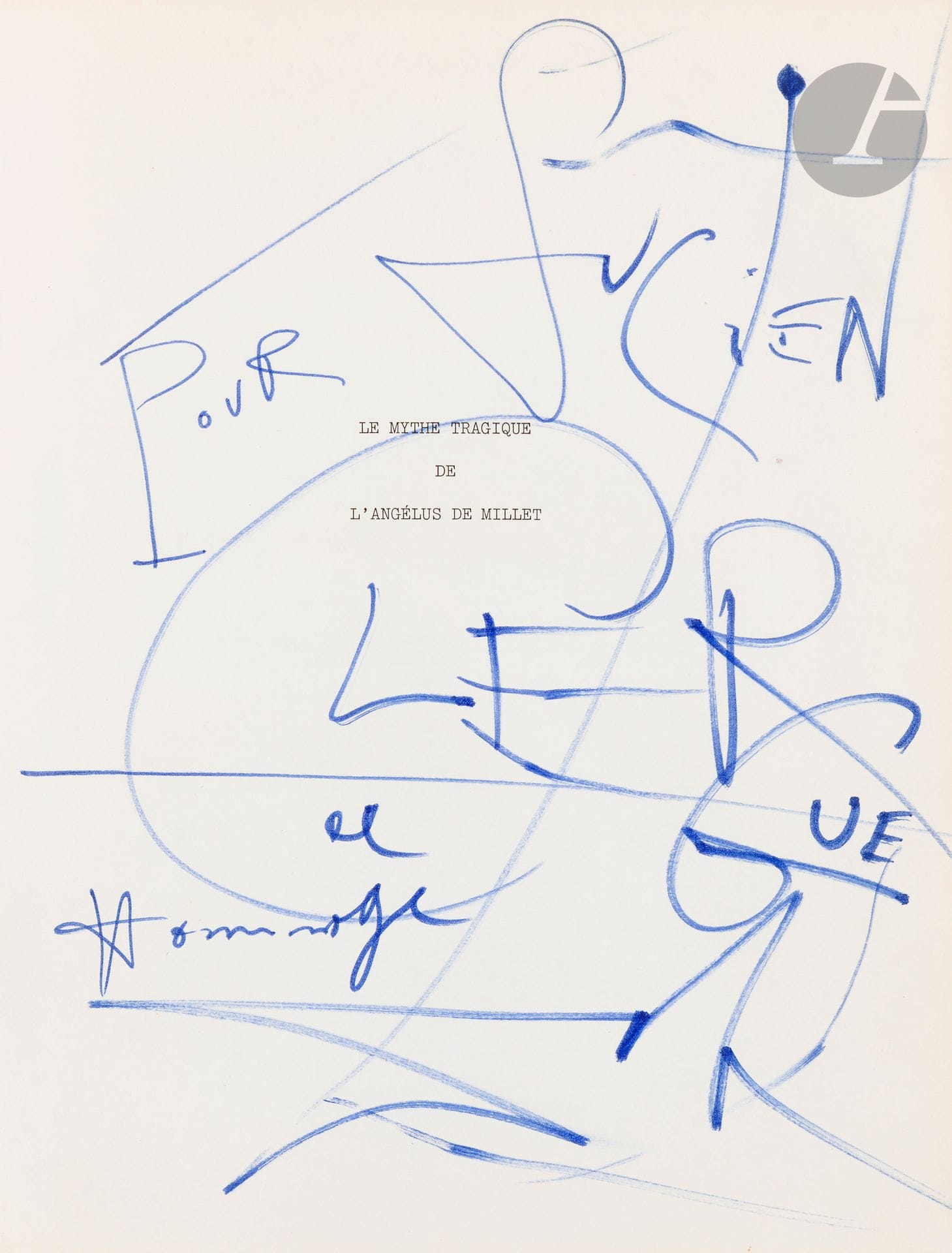
Salvador DALÍ (1904-1989) The tragic myth of Millet's Angelus. A "paranoid-critical" interpretation. Paris: Jean-Jacques Pauvert, (1963). - In-4, 26.9 x 21.2 cm: 105 pp, (3 ff.). Publisher's beige cloth, label and vignette on front board, cloth ribbon and metal buckle in schoolbook style. First edition. "In Le Mythe tragique de l'Angélus de Millet, written in 1938, Dalí applies his process of paranoiac-critical interpretation to Jean-François Millet's painting, analyzing it in terms of personal, irrational and obsessive associations produced by the distinct elements that make it up. In so doing, he completely reverses the usual analyses of this master naturalist painter of French peasant life. In fact, Dalí describes a whole network of hidden meanings, which would tip the painting over into complete eroticism. For him, the fork planted in the earth, with a resolute greed for fertility, signifies sexual penetration. But it also evokes the scalpel used for dissection. Irrational paranoid processes link Eros and Thanatos, sex and death... According to Dalí, the posture of the peasant couple confirms his interpretation. The man is trying to hide his erection... by the shameful and compromising position of his hat. The woman's pose is identified with the very free perforation of the praying mantis, an allusion to the insect's habit of devouring the male after copulation..." (Dalí. The Tragic Myth of Millet's Angelus. Éditions Allia, 2011. Editor's note). Printed in the manner of typewritten texts, the edition is illustrated with numerous full-page photographic reproductions in black or color. An appendix contains an explanation of an illustration from Les Chants de Maldoror. This copy is enriched with a signed autograph letter from Dalí to Lucien Clergue, covering the entire title page: Pour Lucien Clergue // en // Hommage // Dali A very well preserved copy, despite a frayed corner. Missing the sheet opposite the false title, on which was an original drawing signed by Dali.
Estimate
€800 - €1,200
Result
€1,516
Buyer's premium
30%
Salvador DALÍ (1904-1989)
The tragic myth of Millet's Angelus. A "paranoid-critical" interpretation.
Paris: Jean-Jacques Pauvert, (1963). - In-4, 26.9 x 21.2 cm: 105 pp, (3 ff.). Publisher's beige cloth, label and vignette on front board, cloth ribbon and metal buckle in schoolbook style.
First edition.
"In Le Mythe tragique de l'Angélus de Millet, written in 1938, Dalí applies his process of paranoiac-critical interpretation to Jean-François Millet's painting, analyzing it in terms of personal, irrational and obsessive associations produced by the distinct elements that make it up. In so doing, he completely reverses the usual analyses of this master naturalist painter of French peasant life. In fact, Dalí describes a whole network of hidden meanings, which would tip the painting over into complete eroticism. For him, the fork planted in the earth, with a resolute greed for fertility, signifies sexual penetration. But it also evokes the scalpel used for dissection. Irrational paranoid processes link Eros and Thanatos, sex and death... According to Dalí, the posture of the peasant couple confirms his interpretation. The man is trying to hide his erection... by the shameful and compromising position of his hat. The woman's pose is identified with the very free perforation of the praying mantis, an allusion to the insect's habit of devouring the male after copulation..."
(Dalí. The Tragic Myth of Millet's Angelus. Éditions Allia, 2011. Editor's note).
Printed in the manner of typewritten texts, the edition is illustrated with numerous full-page photographic reproductions in black or color. An appendix contains an explanation of an illustration from Les Chants de Maldoror.
This copy is enriched with a signed autograph letter from Dalí to Lucien Clergue, covering the entire title page:
Pour Lucien Clergue // en // Hommage // Dali
A very well preserved copy, despite a frayed corner. Missing the sheet opposite the false title, on which was an original drawing signed by Dali.
Sale
Thursday 10 April 2025・14:00 (Europe/Paris)
Salle 9 - Hôtel Drouot
9, rue Drouot
75009 Paris