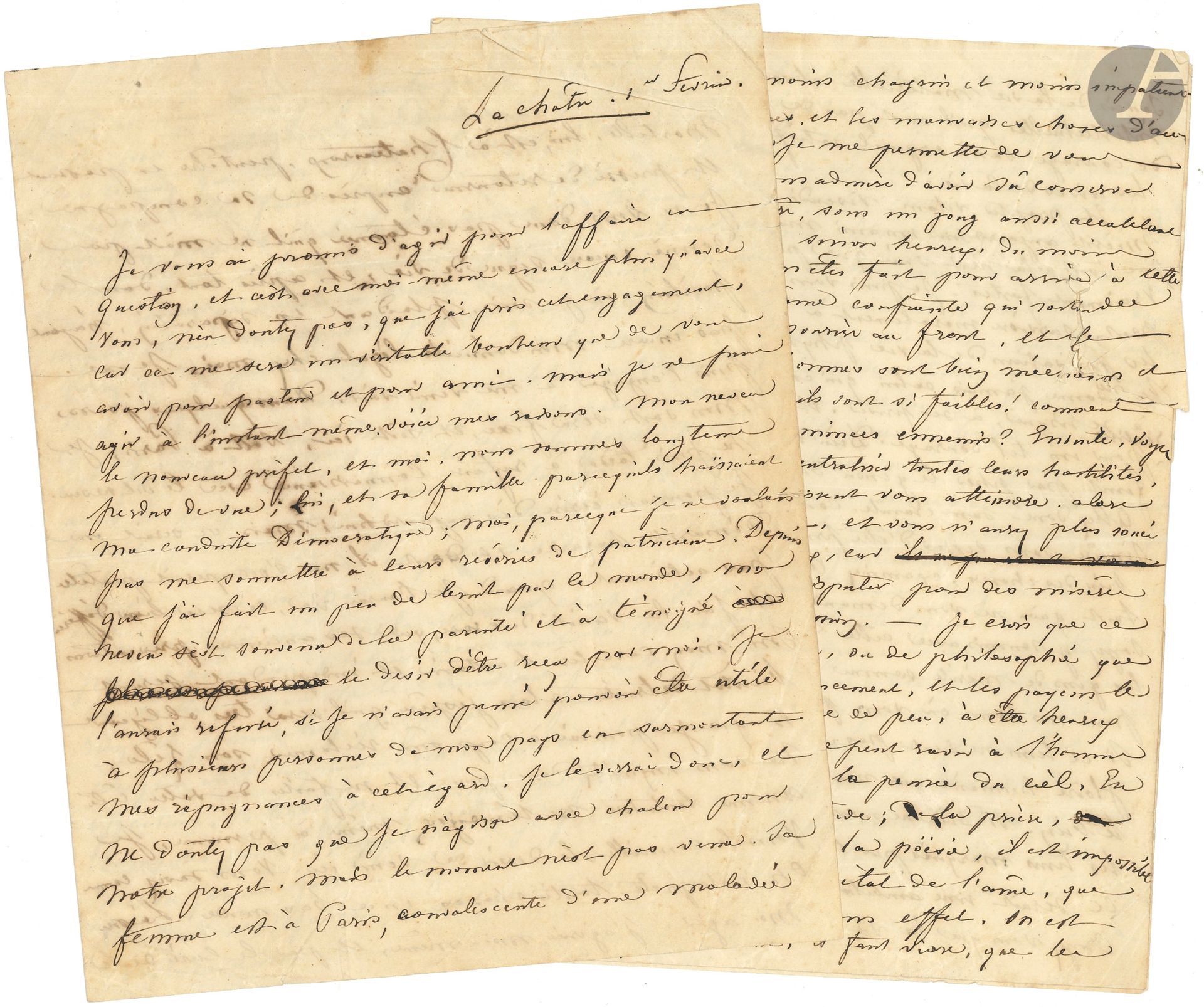
George SAND (1804-1876). L.A.S. "G", La Châtre February 1 [1836], to Abbé Georges Rochet, "desservant de La Champenoise"; 9pages in-4, addressed (small tears to last ff. without loss of text). Long, superb letter on her separation lawsuit against her husband, her work on the new version of Lélia, and on philosophy and religion. [Abbé George Rochet (1803-1881), an unorthodox Berrichon priest, had begun a philosophical correspondence with Sand in December 1835; he stayed in Nohant on several occasions]. The beginning of the letter concerns Rochet's wish to be appointed to the curacy of Saint-Chartier (whose parish priest had just died), and Sand would certainly be happy to have him "for pastor and friend". But she is at odds with her nephew, the new Prefect of Indre (Léonce Vallet de Villeneuve), "he and his family, because they hated my democratic conduct; I, because I didn't want to submit to their patrician reveries". He seems to want to get closer to her; but "in the position I'm in, pleading separation, not yet having my legal domicile at home, I can't get him to come and see me". She hopes to be able to act on Rochet's behalf soon, and would be ready to go and see the Archbishop of Bourges. "But you can imagine that in the uncertain position I'm in, I can do nothing. My trial will be judged by public opinion as soon as it is judged by the courts. Men are so vain in their judgments, that one is only allowed to be right by virtue of the judgment of three often inept, often corrupt men. If I lose my château, you will see that I will lose many smiles and many curtseys. If, on the other hand, I win it, I'll be as white as snow and I'll be able to claim my great kinsmen as my own. This is how society is: you have to wage war against it to have peace, you have to defeat it and make it sign the treaty that assures our dignity and rest, or you have to surrender at mercy and wear its chains. The latter does not suit me"... She lends Rochet her novel Lélia, borrowed from a friend: "This work has become very rare. I hope soon to offer you the complete new edition of my musings. Be indulgent for Lélia. This is no dish for an ordinary priest. But you are above the human institution, on the level of the divine institution. Then, if you know how to read, you'll see that I haven't concluded anything, and that I've painted human suffering, hope grappling with doubt. The fable is an allegory through and through, and each character represents a passion, or a faculty. When you've finished it, search and you'll find. Or interpret it as you please, and it will be just as good. She also sends him two volumes of Plato, and asks for his novel Jacques: "I need it to correct the second edition, and I don't have another copy". Then she advises Rochet, expressing her ideas on life, society and religion. She would like him to be "less chagrined and less impatient with bad men, and the bad things of today", and to arrive "at that serenity of the confident soul which emerges from the harsh trials of life, with a smile on its forehead, and forgiveness on its lips. I agree that men are wicked and vile, but they are so weak! How can we fail to be gracious to such slender enemies? [...] you'll see them fighting over miseries you'll despise possessing. - I believe that this means is a kind of virtue, or philosophy that Christians call renunciation, and pagans call stoicism. It is to learn to live on little, to be happy with the only goods that man cannot take away from man, the contemplation of the universe, the thought of heaven. By savoring the delights of solitude, prayer, meditation, study and poetry, it is impossible not to arrive at such a state of the soul, that external events are without effect. [...] I can tell you from experience that one can survive morally all the disasters and privations of physical life. Hope for the best never abandons those who are determined to work, to tire, to risk, to deprive themselves. And this hope always comes true for such courage. God stretches out his arms, and society finally bows the knee before him. So go without fear, and without boasting. Be sincere, without ceasing to be cautious. Transiently smile at many things [...] Reserve your strength for a time when you can make noble use of it. If that time does not come, what does it matter? It is not human glory that we seek, but the means to do good. If God does not offer us
Estimate
€2,500 - €3,000
Result
Not sold
Buyer's premium
30%
George SAND (1804-1876). L.A.S. "G", La Châtre February 1 [1836], to Abbé Georges Rochet, "desservant de La Champenoise"; 9pages in-4, addressed (small tears to last ff. without loss of text).
Long, superb letter on her separation lawsuit against her husband, her work on the new version of Lélia, and on philosophy and religion.
[Abbé George Rochet (1803-1881), an unorthodox Berrichon priest, had begun a philosophical correspondence with Sand in December 1835; he stayed in Nohant on several occasions].
The beginning of the letter concerns Rochet's wish to be appointed to the curacy of Saint-Chartier (whose parish priest had just died), and Sand would certainly be happy to have him "for pastor and friend". But she is at odds with her nephew, the new Prefect of Indre (Léonce Vallet de Villeneuve), "he and his family, because they hated my democratic conduct; I, because I didn't want to submit to their patrician reveries". He seems to want to get closer to her; but "in the position I'm in, pleading separation, not yet having my legal domicile at home, I can't get him to come and see me". She hopes to be able to act on Rochet's behalf soon, and would be ready to go and see the Archbishop of Bourges. "But you can imagine that in the uncertain position I'm in, I can do nothing. My trial will be judged by public opinion as soon as it is judged by the courts. Men are so vain in their judgments, that one is only allowed to be right by virtue of the judgment of three often inept, often corrupt men. If I lose my château, you will see that I will lose many smiles and many curtseys. If, on the other hand, I win it, I'll be as white as snow and I'll be able to claim my great kinsmen as my own. This is how society is: you have to wage war against it to have peace, you have to defeat it and make it sign the treaty that assures our dignity and rest, or you have to surrender at mercy and wear its chains. The latter does not suit me"...
She lends Rochet her novel Lélia, borrowed from a friend: "This work has become very rare. I hope soon to offer you the complete new edition of my musings. Be indulgent for Lélia. This is no dish for an ordinary priest. But you are above the human institution, on the level of the divine institution. Then, if you know how to read, you'll see that I haven't concluded anything, and that I've painted human suffering, hope grappling with doubt. The fable is an allegory through and through, and each character represents a passion, or a faculty. When you've finished it, search and you'll find. Or interpret it as you please, and it will be just as good. She also sends him two volumes of Plato, and asks for his novel Jacques: "I need it to correct the second edition, and I don't have another copy".
Then she advises Rochet, expressing her ideas on life, society and religion. She would like him to be "less chagrined and less impatient with bad men, and the bad things of today", and to arrive "at that serenity of the confident soul which emerges from the harsh trials of life, with a smile on its forehead, and forgiveness on its lips. I agree that men are wicked and vile, but they are so weak! How can we fail to be gracious to such slender enemies? [...] you'll see them fighting over miseries you'll despise possessing. - I believe that this means is a kind of virtue, or philosophy that Christians call renunciation, and pagans call stoicism. It is to learn to live on little, to be happy with the only goods that man cannot take away from man, the contemplation of the universe, the thought of heaven. By savoring the delights of solitude, prayer, meditation, study and poetry, it is impossible not to arrive at such a state of the soul, that external events are without effect. [...] I can tell you from experience that one can survive morally all the disasters and privations of physical life. Hope for the best never abandons those who are determined to work, to tire, to risk, to deprive themselves. And this hope always comes true for such courage. God stretches out his arms, and society finally bows the knee before him. So go without fear, and without boasting. Be sincere, without ceasing to be cautious. Transiently smile at many things [...] Reserve your strength for a time when you can make noble use of it. If that time does not come, what does it matter? It is not human glory that we seek, but the means to do good. If God does not offer us
Sale
Wednesday 11 March・14:00 (Europe/Paris)
Sale location coming soon
3, rue Favart
75002 Paris