GUIGNES (Chrétien-Louis-Joseph de). Voyages à Péking, Manille et l'île de France, faits Dans l'intervalle des années 1784 à 1801. Paris: Imprimerie impériale, 1808. -3 volumes in-8, 210x137, and an atlas in-folio, 410x260: (2 ff.), lxiij, 439 pp.; (2 ff.), 476 pp.; (2 ff.), 488 pp.; (2 ff.), 60 plates, 6 maps. Long-grained red half-maroquin with small corners, gilt roulettes, smooth spine decorated, untrimmed (contemporary binding). First edition of this sought-after work, the last European account of classical imperial China, before the Opium Wars and Westernization brought lasting changes to the Middle Kingdom. The sinologist and orientalist Chrétien-Louis-Joseph de Guignes (1759-1845) was the son of the orientalist Joseph de Guignes (1721-1800), who passed on to him his mastery of Chinese. He was a major figure in cultural exchanges between Europe and China. Appointed French consul in Canton in 1784, he lived in China until 1801. In 1793-1794, he accompanied the Dutch ambassador to Peking as an interpreter, and was received at the sumptuous Summer Palace - later destroyed in 1860 by Lord Elgin's punitive expedition. In his preface, the author states that his aim in this book is to describe China as he observed it, without idealizing or denigrating it. He relies on concrete facts, avoiding pronouncements on historical periods that are too old and uncertain, since even Chinese historians themselves have avoided deciding on these distant eras. He begins with an overview of China's early history, highlighting its unreliability before a more documented period, and shows that the empire, far from existing since 3,000 BC, did not stabilize until much later. The second part relates his journey to Peking, described in a factual and unvarnished manner, as an authentic account of his journey through the empire. He includes geographical and administrative details to provide a concrete basis for future travelers. The third part brings together his observations on China, the fruit of his long residence: customs, government, religion, trade, and even reflections on the beauty or ugliness of different cultures. He also discusses trade relations between China and Europe, as well as the geography and natural resources of the regions he visited. The text is accompanied by a beautiful atlas of scenes, monuments and landscapes, drawn by the author himself. It includes 92 subjects spread over 60 plates, followed by 6 beautiful maps and plans: Map of the route the author took across the Chinese Empire. - Map of Macao. - Map of the river from Macao to Canton. - Map of the Philippine Islands. - Map of Manila Bay. A good copy in contemporary binding, preserved at full margins, from the library of Count Frédéric de Pourtalès (1779-1861), a Swiss soldier and politician. An officer in the service of Prussia and then France, he became aide-de-camp to Marshal Berthier and was made a Comte d'Empire by Napoleon in 1809. After 1814, he joined Prussia, which confirmed his title, and held military posts in Neuchâtel. He ended his career as Grand Master of Ceremonies at the Prussian Court (1842-1848). Numerous wear and tear marks to bindings, head cover of first text volume and atlas covers worn, corners dulled. Some scattered foxing. Provenance: Frédéric de Pourtalès, with bookplate. - P. R. Duperray, with bookplate.
Estimate
€2,000 - €3,000
Result
€3,538
Buyer's premium
30%
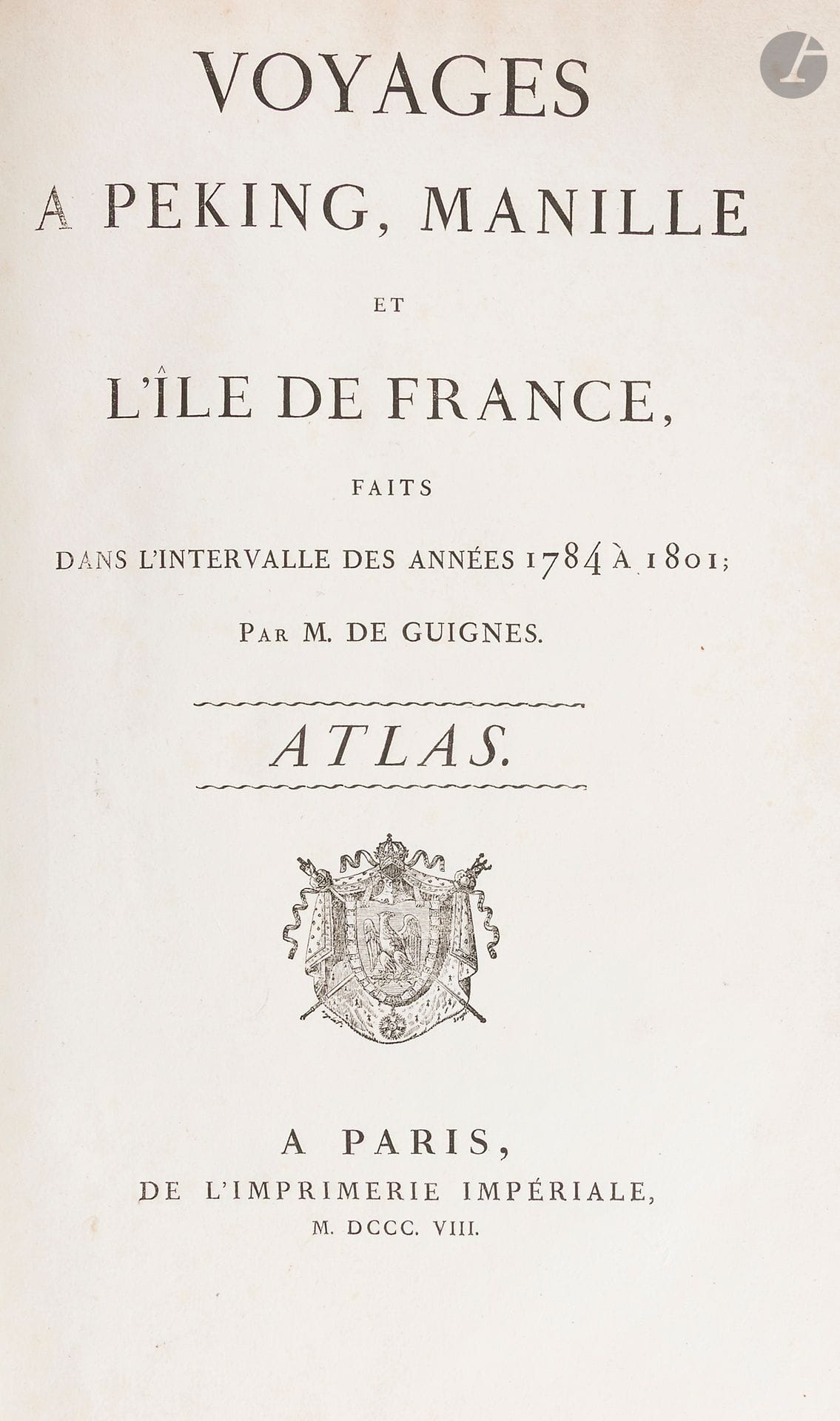
GUIGNES (Chrétien-Louis-Joseph de).
Voyages à Péking, Manille et l'île de France, faits Dans l'intervalle des années 1784 à 1801.
Paris: Imprimerie impériale, 1808. -3 volumes in-8, 210x137, and an atlas in-folio, 410x260: (2 ff.), lxiij, 439 pp.; (2 ff.), 476 pp.; (2 ff.), 488 pp.; (2 ff.), 60 plates, 6 maps. Long-grained red half-maroquin with small corners, gilt roulettes, smooth spine decorated, untrimmed (contemporary binding).
First edition of this sought-after work, the last European account of classical imperial China, before the Opium Wars and Westernization brought lasting changes to the Middle Kingdom.
The sinologist and orientalist Chrétien-Louis-Joseph de Guignes (1759-1845) was the son of the orientalist Joseph de Guignes (1721-1800), who passed on to him his mastery of Chinese. He was a major figure in cultural exchanges between Europe and China.
Appointed French consul in Canton in 1784, he lived in China until 1801. In 1793-1794, he accompanied the Dutch ambassador to Peking as an interpreter, and was received at the sumptuous Summer Palace - later destroyed in 1860 by Lord Elgin's punitive expedition.
In his preface, the author states that his aim in this book is to describe China as he observed it, without idealizing or denigrating it. He relies on concrete facts, avoiding pronouncements on historical periods that are too old and uncertain, since even Chinese historians themselves have avoided deciding on these distant eras.
He begins with an overview of China's early history, highlighting its unreliability before a more documented period, and shows that the empire, far from existing since 3,000 BC, did not stabilize until much later.
The second part relates his journey to Peking, described in a factual and unvarnished manner, as an authentic account of his journey through the empire. He includes geographical and administrative details to provide a concrete basis for future travelers.
The third part brings together his observations on China, the fruit of his long residence: customs, government, religion, trade, and even reflections on the beauty or ugliness of different cultures. He also discusses trade relations between China and Europe, as well as the geography and natural resources of the regions he visited.
The text is accompanied by a beautiful atlas of scenes, monuments and landscapes, drawn by the author himself. It includes 92 subjects spread over 60 plates, followed by 6 beautiful maps and plans: Map of the route the author took across the Chinese Empire. - Map of Macao. - Map of the river from Macao to Canton. - Map of the Philippine Islands. - Map of Manila Bay.
A good copy in contemporary binding, preserved at full margins, from the library of Count Frédéric de Pourtalès (1779-1861), a Swiss soldier and politician. An officer in the service of Prussia and then France, he became aide-de-camp to Marshal Berthier and was made a Comte d'Empire by Napoleon in 1809. After 1814, he joined Prussia, which confirmed his title, and held military posts in Neuchâtel. He ended his career as Grand Master of Ceremonies at the Prussian Court (1842-1848).
Numerous wear and tear marks to bindings, head cover of first text volume and atlas covers worn, corners dulled. Some scattered foxing.
Provenance:
Frédéric de Pourtalès, with bookplate. - P. R. Duperray, with bookplate.
Sale
Wednesday 17 June・14:00 (Europe/Paris)
Sale location coming soon
3, rue Favart
75002 Paris