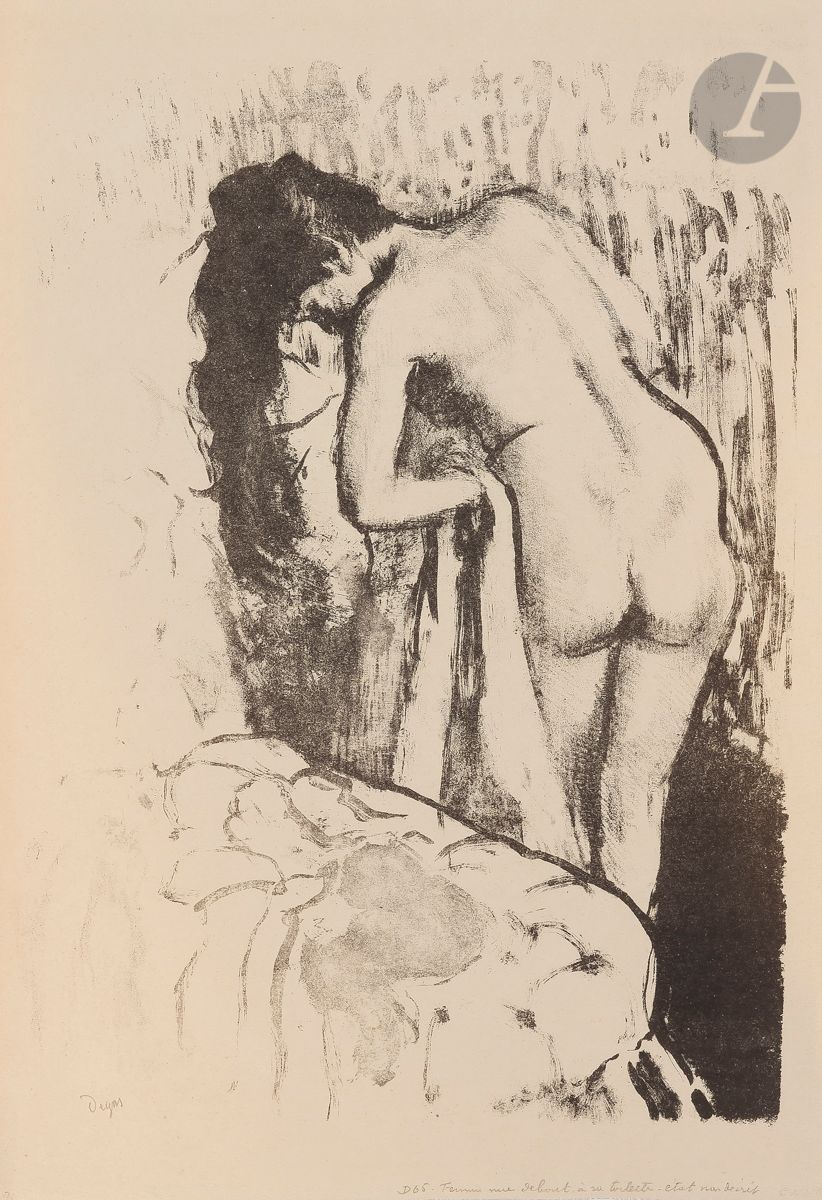
Edgar Degas (1834-1917) Femme nue debout à sa toilette. 1891-1892. Lithographie (transfert depuis un monotype, crayon lithographique et grattoir). 235 x 328 [262 x 375]. Delteil 65 ; Reed-Shapiro 61 (vi/vi). Très belle et fraîche épreuve sur vélin ivoire, signée au crayon. « The bather lithographs were Degas’s last effort in printmaking. […] In the 1950s, E. Kornfeld found a relatively large number of impressions of some of the bather lithographs in the hands of Maurice Exsteens, who had acquired them from his father-in-law, the Parisian collector and publisher Gustave Pellet (1859-1919). Pellet had evidently obtained them some time between 1900 and 1910 and is said to have had them signed by Degas. […] Uncertainties remain about some of the techniques, for Degas and his printer employed unusual combinations of materials and processes : greasy drawings on celluloid, coated transfer papers that produced unexpected granular patches, photographic transfer, and direct work on the stone. As a group the bather lithographs vividly illustrate Degas’s inventive, and sometimes unique, working methods. » (Sue Welsh Reed et Barbara Stern Shapiro, dir., Edgar Degas, The Painter as Printmaker, Boston, Museum of Fine Arts, 1984, p. 220).
Estimation
18 000 € - 20 000 €
Résultat
24 320 €
Frais de vente
28%
Edgar Degas (1834-1917)
Femme nue debout à sa toilette. 1891-1892. Lithographie (transfert depuis un monotype, crayon lithographique et grattoir). 235 x 328 [262 x 375]. Delteil 65 ; Reed-Shapiro 61 (vi/vi). Très belle et fraîche épreuve sur vélin ivoire, signée au crayon.
« The bather lithographs were Degas’s last effort in printmaking. […] In the 1950s, E. Kornfeld found a relatively large number of impressions of some of the bather lithographs in the hands of Maurice Exsteens, who had acquired them from his father-in-law, the Parisian collector and publisher Gustave Pellet (1859-1919). Pellet had evidently obtained them some time between 1900 and 1910 and is said to have had them signed by Degas.
[…] Uncertainties remain about some of the techniques, for Degas and his printer employed unusual combinations of materials and processes : greasy drawings on celluloid, coated transfer papers that produced unexpected granular patches, photographic transfer, and direct work on the stone. As a group the bather lithographs vividly illustrate Degas’s inventive, and sometimes unique, working methods. »
(Sue Welsh Reed et Barbara Stern Shapiro, dir., Edgar Degas, The Painter as Printmaker, Boston, Museum of Fine Arts, 1984, p. 220).
Vente
jeudi 12 mai 2022・14:00 (Europe/Paris)
Lieu de vente à venir
3, rue Favart
75002 Paris