

Lot n° 16
Estimation :
6000 - 8000
EUR
Result with fees
Result
: 23 040EUR
Antonio Fantuzzi (active around 1540 - Lot 16
Antonio Fantuzzi (active around 1540
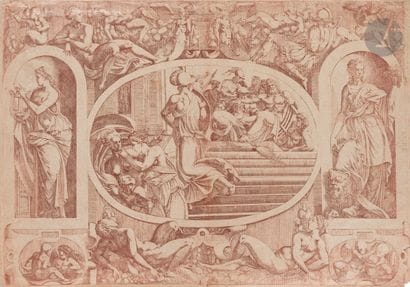
)Artemis, Athena and Aphrodite leaving Olympus. 1543. Etching after F. Primaticcio. [508 x 355]. Bartsch 21; Hollstein 18; Zerner 55; Jenkins AF 55. Exceptional trial proof printed in sanguine on both sides. Small inscription "126" in the lower right corner of the image. On the reverse at the foot, a small engraved ornamental band drawn out of order in the margin. Traces of folds including printing folds, the median vertical drying fold formerly restored at the head on the verso. Minor surface thinning or spotting, tiny holes visible through transparency. Small lack in the lower right corner. Mounted with two matted tabs, these tabs glued to the top edge at the head on the reverse, inside the image.
"This etching, together with other prints and drawings, records a lost cycle by Primaticcio. [...] It is not known where at Fontainebleau these scenes illustrating the Story of Troy were represented. Fantuzzi's etching is unusual in showing both the central image and surrounding frame in a single print, providing important evidence on the appearance of the decorative scheme. Primaticcio's preparatory drawing for the central narrative was formerly in the collection of Ian Woodner [...], and his study for the female figure with the lion is in the Berlin Kupferstichskabinett." (Catherine Jenkins, Prints at the Court of Fontainebleau, c. 1542-47, "Studies in Prints and Printmaking, vol. VII, Oudekerke aan den Ijsell, Sound & Vision Publishers, 2017, II, p. 198).
"There are, however, a few ways in which the artists did seek to achieve original effects, most strikingly with the use of colored inks, Fantuzzi in particular but also Davent, Mignon and a few anonymous hands experimented with the use of red inks, which range from oranges to deep burgundies and browns. The approximately sixty colored Fontainebleau etchings I have recorded are all on contemporary paper and appear to have been printed about 1542-43. Only a few earlier artists had produced intaglio prints in color, and when they did, it tended to be in more muted tones such as browns." (Ibid., p. 43).
My orders
Sale information
Sales conditions
Return to catalogue